Law Careers
How Long Does It Take to Become a Solicitor?
A complete guide to how long qualification as a solicitor actually takes, covering every stage from degree to newly qualified, the honest average, and what affects the timeline.

EO Careers Team
If you are planning a career in commercial law as a non-law graduate, our Law Careers hub covers qualification routes, practice areas, salaries, and the skills that matter in applications.
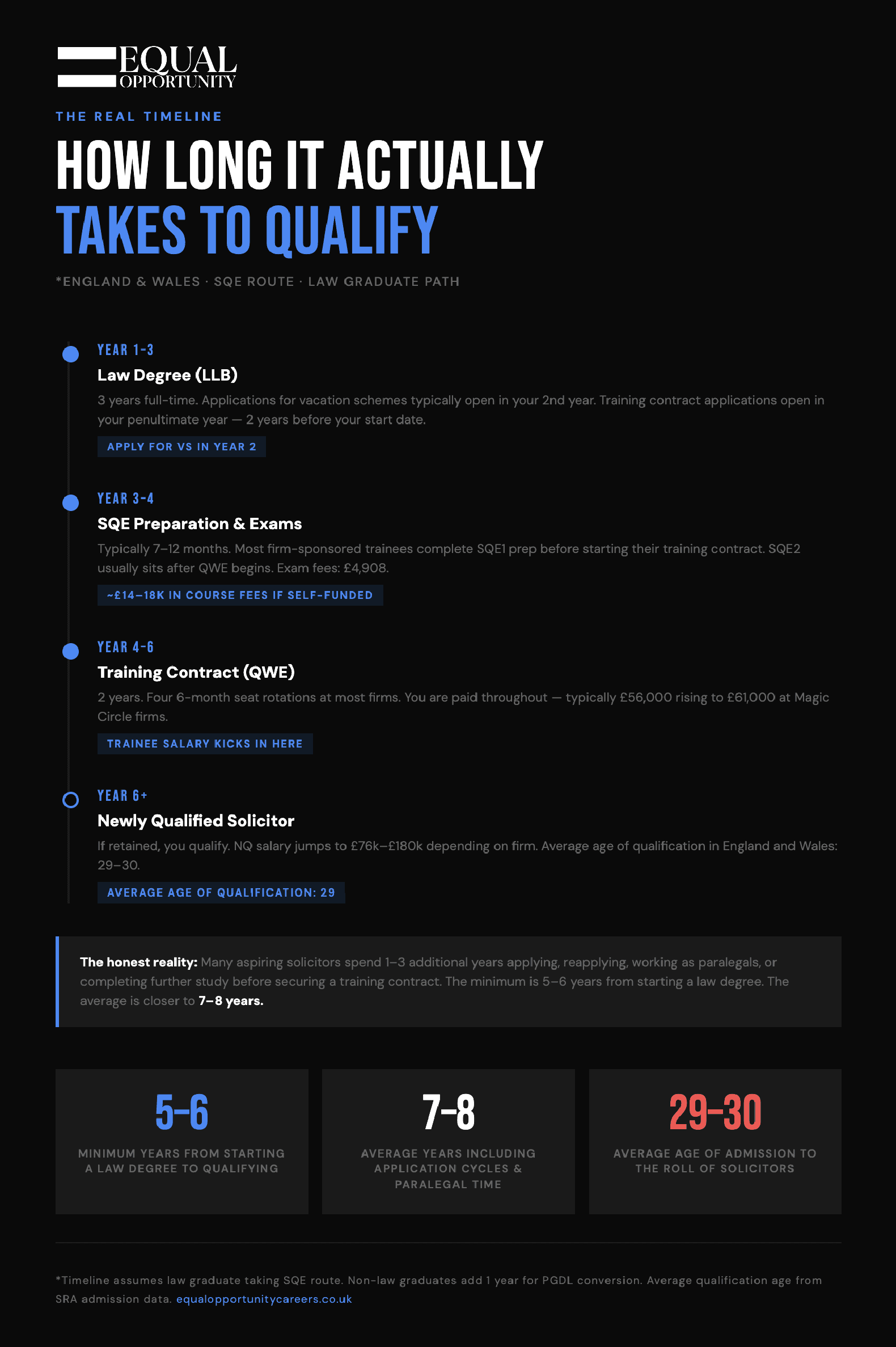
The minimum time it takes to become a solicitor in England and Wales is five to six years from starting a law degree. The average, once you account for application cycles, paralegal time, and the reality of how competitive training contract recruitment is, is closer to seven to eight years. The average age of admission to the roll of solicitors is 29 to 30.
These numbers are not designed to discourage anyone. They are the honest picture, and understanding the real timeline before you start is more useful than discovering it halfway through. The infographic above maps the full journey. This guide explains each stage, what it costs, what it involves, and the variables that can extend or compress the timeline.
Stage 1: The law degree (years 1 to 3)
A qualifying law degree takes three years full-time. It covers the seven Foundations of Legal Knowledge required by the SRA and provides the academic grounding in legal analysis that underpins everything that follows.
The degree is also when the application process begins in earnest, which most students do not fully appreciate until they are already in it. Vacation scheme applications at large commercial firms open in the second year of a law degree, typically in October, and training contract applications at many firms open simultaneously or shortly after. The recruitment process is not something that begins after graduation. For students targeting Magic Circle and Silver Circle firms, it is something that begins before their final year.
First-year insight schemes and spring weeks are available from year one and are worth pursuing from the outset, not because they are required but because they build the firm-specific knowledge and commercial awareness that make vacation scheme applications specific rather than generic. For a full guide to these programmes, see our first year schemes guide.
For non-law graduates, add one year for the PGDL conversion course before the SQE preparation stage. Non-law graduates taking the full route therefore face a minimum of six to seven years rather than five to six. For a detailed comparison of the law and non-law routes, see our law degree vs non-law degree guide.
Stage 2: SQE preparation and exams (years 3 to 4)
The Solicitors Qualifying Examination replaced the Legal Practice Course in 2021 and is now the assessment that every aspiring solicitor in England and Wales must pass. It has two parts.
SQE1 consists of two multiple-choice assessments covering Functioning Legal Knowledge across all major practice areas. Most candidates sit SQE1 before their training contract begins, typically as part of a funded preparation course provided by their training contract firm. SQE preparation programmes are offered by University of Law, BPP, Barbri, and others, and typically run for seven to twelve months alongside or immediately after the degree.
SQE2 consists of six skills assessments covering legal research, writing, drafting, legal analysis, client communication, and advocacy. Most firm-sponsored trainees sit SQE2 during or after their training contract period, once they have accumulated enough practical experience to demonstrate these skills at the required level.
The SRA exam fees for SQE1 and SQE2 combined are currently £4,908. Course preparation fees on top of this are significant: self-funded candidates typically pay £14,000 to £18,000 for preparation courses. Candidates with training contracts at large commercial firms have these fees paid in full by the firm, alongside a maintenance grant of £15,000 to £20,000 per year during the study period.
For a full explanation of how the SQE works, what each assessment involves, and how it connects to the training contract, see our SQE guide.
Stage 3: The training contract (years 4 to 6)
The training contract is the two-year period of supervised practical legal work that, alongside the SQE, qualifies you to practise as a solicitor. You are paid throughout: trainees at Magic Circle firms currently earn £56,000 rising to £61,000 in year two. At US firms in London, trainee salaries are typically £60,000 to £70,000. At regional firms, salaries start around £28,000 depending on location and firm type.
Most training contracts involve four six-month seat rotations through different practice areas. Some firms structure theirs differently: Freshfields runs eight three-month seats, and Jones Day operates a non-rotational model. Seat rotation gives trainees broad exposure to different areas of law before choosing a qualification seat, which determines the practice area they qualify into as a newly qualified solicitor.
The training contract also constitutes the two years of Qualifying Work Experience the SRA requires for admission to the roll. At the end of the contract, assuming successful completion of both SQE1 and SQE2 and satisfactory QWE sign-off from the firm, the trainee applies for admission and qualifies as a solicitor.
For a full guide to what a training contract involves day to day, see our what is a training contract guide.
Stage 4: Newly qualified solicitor (year 6 onwards)
On qualification, a trainee becomes a newly qualified (NQ) solicitor and joins the firm's associate pool in their chosen practice area. The NQ salary jump is significant: at Magic Circle firms, NQ solicitors currently earn £150,000. At US firms, NQ salaries are £170,000 to £180,000. At regional firms, NQ salaries typically range from £35,000 to £60,000 depending on location and firm.
The average age of admission to the roll of solicitors in England and Wales, based on SRA data, is 29 to 30. For a law graduate who starts university at 18 and follows a relatively direct path, qualification at 26 or 27 is achievable. The gap between that theoretical minimum and the actual average reflects the reality described below.
The honest reality: why the average is 7 to 8 years
The minimum timeline assumes everything goes to plan: a competitive vacation scheme application succeeds in the second year of the degree, a training contract offer follows, SQE preparation is completed efficiently, and the training contract runs without interruption. For a minority of candidates, particularly those targeting the most competitive firms and who apply early, prepare thoroughly, and secure offers in their first application cycle, this is approximately what happens.
For most candidates, at least one of the following adds time to the journey.
Multiple application cycles. Training contract recruitment at large commercial firms is highly competitive. Many excellent candidates do not secure a vacation scheme or training contract in their first application cycle, and some take two or three cycles before receiving an offer. Each cycle adds six to twelve months to the timeline. This is not unusual, it is the norm, and it does not disqualify you from qualifying at a strong firm. The candidates who succeed after multiple cycles are those who treat each rejection as useful feedback rather than a final verdict.
Paralegal time. Many candidates work as paralegals between their degree and their training contract, either because they are building their applications and experience, or because they have training contracts starting at a future date and are filling the intervening period productively. Paralegal work now counts as Qualifying Work Experience under the SQE framework, which means it can contribute toward the two-year QWE requirement rather than being time outside the qualification process. For a full explanation of how the paralegal route to qualification works, see our paralegal guide.
The gap year between degree and training contract start. Even candidates who secure training contracts in their second year at university may not start their contracts until two years after graduation. Large commercial firms typically offer training contracts that begin two years from the offer date, which means a second-year student accepting an offer in November will not start until two years later. This gap is typically filled with SQE preparation, travel, further study, or paralegal work, but it adds to the overall timeline.
Additional study. Some candidates complete a Masters degree, a GDL or PGDL conversion, or further academic work before or during their qualification journey. Non-law graduates add at least one year for conversion. Candidates who choose to complete an LLM or other postgraduate qualification add further time.
None of these extensions represent failure. They represent the reality of a competitive profession with a multi-stage qualification process. The candidates who qualify at 29 or 30 having taken a less linear path often arrive at their NQ year with broader experience, stronger applications, and a clearer sense of the kind of work they want to do than those who followed the most direct route.
The apprenticeship route: an alternative timeline
The Level 7 Solicitor Apprenticeship offers a different timeline entirely, and one that is increasingly worth considering for candidates who want to qualify without a traditional university degree or who want to enter the workforce earlier.
The apprenticeship combines working at a law firm with studying for a degree-equivalent qualification and completing the SQE, all simultaneously. It typically takes six years from start to qualification. The significant difference from the traditional route is that it is entirely employer-funded, candidates earn a salary throughout, and they avoid both the cost of a university degree and the cost of SQE preparation courses.
The tradeoff is that apprenticeships at large commercial firms are themselves competitive, that the simultaneous demands of working, studying, and preparing for the SQE are substantial, and that the qualification timeline, while similar in length, involves a different kind of intensity from the traditional route.
For a full comparison of the apprenticeship and university routes, see our apprenticeships vs university guide.
A summary of the timelines
Route | Minimum years | Realistic average |
|---|---|---|
Law degree (LLB) + SQE + training contract | 5 to 6 years | 7 to 8 years |
Non-law degree + PGDL + SQE + training contract | 6 to 7 years | 8 to 9 years |
Level 7 Solicitor Apprenticeship | 6 years | 6 to 7 years |
These figures assume qualification in England and Wales under the SQE framework. Scotland and Northern Ireland have separate qualification routes and different timelines.
What you can do right now to make the timeline as efficient as possible
The single most effective thing you can do to compress the timeline is to start early. Not in the sense of deciding at 15 that you want to be a solicitor, but in the sense of beginning the application process in the second year of your degree rather than the third, attending first-year schemes in your first year, building commercial awareness from the beginning of university rather than scrambling to develop it in the month before applications open, and treating each application cycle as an opportunity to improve rather than a judgment on your suitability.
The candidates who qualify at 26 or 27 are not categorically more able than those who qualify at 30. They are those who started earlier, applied more strategically, and used the time between degree and training contract productively. The guidance on how to do that is spread across every section of this site, from how to research a law firm to how to get a training contract to commercial awareness.
Ready to start the process?
The Future Trainee Academy covers the full qualification journey from first-year schemes through to training contract applications and assessment centres, with guidance from a recruiter who has interviewed over 10,000 candidates. Free to access.
For a full breakdown of what trainees and newly qualified solicitors earn at every tier of the market, see our law firm salaries guide.
Related Articles


Related Articles

Law Careers
How Long Does It Take to Become a Solicitor?
A complete guide to how long qualification as a solicitor actually takes, covering every stage from degree to newly qualified, the honest average, and what affects the timeline.
EO Careers Team
If you are planning a career in commercial law as a non-law graduate, our Law Careers hub covers qualification routes, practice areas, salaries, and the skills that matter in applications.
The minimum time it takes to become a solicitor in England and Wales is five to six years from starting a law degree. The average, once you account for application cycles, paralegal time, and the reality of how competitive training contract recruitment is, is closer to seven to eight years. The average age of admission to the roll of solicitors is 29 to 30.
These numbers are not designed to discourage anyone. They are the honest picture, and understanding the real timeline before you start is more useful than discovering it halfway through. The infographic above maps the full journey. This guide explains each stage, what it costs, what it involves, and the variables that can extend or compress the timeline.
Stage 1: The law degree (years 1 to 3)
A qualifying law degree takes three years full-time. It covers the seven Foundations of Legal Knowledge required by the SRA and provides the academic grounding in legal analysis that underpins everything that follows.
The degree is also when the application process begins in earnest, which most students do not fully appreciate until they are already in it. Vacation scheme applications at large commercial firms open in the second year of a law degree, typically in October, and training contract applications at many firms open simultaneously or shortly after. The recruitment process is not something that begins after graduation. For students targeting Magic Circle and Silver Circle firms, it is something that begins before their final year.
First-year insight schemes and spring weeks are available from year one and are worth pursuing from the outset, not because they are required but because they build the firm-specific knowledge and commercial awareness that make vacation scheme applications specific rather than generic. For a full guide to these programmes, see our first year schemes guide.
For non-law graduates, add one year for the PGDL conversion course before the SQE preparation stage. Non-law graduates taking the full route therefore face a minimum of six to seven years rather than five to six. For a detailed comparison of the law and non-law routes, see our law degree vs non-law degree guide.
Stage 2: SQE preparation and exams (years 3 to 4)
The Solicitors Qualifying Examination replaced the Legal Practice Course in 2021 and is now the assessment that every aspiring solicitor in England and Wales must pass. It has two parts.
SQE1 consists of two multiple-choice assessments covering Functioning Legal Knowledge across all major practice areas. Most candidates sit SQE1 before their training contract begins, typically as part of a funded preparation course provided by their training contract firm. SQE preparation programmes are offered by University of Law, BPP, Barbri, and others, and typically run for seven to twelve months alongside or immediately after the degree.
SQE2 consists of six skills assessments covering legal research, writing, drafting, legal analysis, client communication, and advocacy. Most firm-sponsored trainees sit SQE2 during or after their training contract period, once they have accumulated enough practical experience to demonstrate these skills at the required level.
The SRA exam fees for SQE1 and SQE2 combined are currently £4,908. Course preparation fees on top of this are significant: self-funded candidates typically pay £14,000 to £18,000 for preparation courses. Candidates with training contracts at large commercial firms have these fees paid in full by the firm, alongside a maintenance grant of £15,000 to £20,000 per year during the study period.
For a full explanation of how the SQE works, what each assessment involves, and how it connects to the training contract, see our SQE guide.
Stage 3: The training contract (years 4 to 6)
The training contract is the two-year period of supervised practical legal work that, alongside the SQE, qualifies you to practise as a solicitor. You are paid throughout: trainees at Magic Circle firms currently earn £56,000 rising to £61,000 in year two. At US firms in London, trainee salaries are typically £60,000 to £70,000. At regional firms, salaries start around £28,000 depending on location and firm type.
Most training contracts involve four six-month seat rotations through different practice areas. Some firms structure theirs differently: Freshfields runs eight three-month seats, and Jones Day operates a non-rotational model. Seat rotation gives trainees broad exposure to different areas of law before choosing a qualification seat, which determines the practice area they qualify into as a newly qualified solicitor.
The training contract also constitutes the two years of Qualifying Work Experience the SRA requires for admission to the roll. At the end of the contract, assuming successful completion of both SQE1 and SQE2 and satisfactory QWE sign-off from the firm, the trainee applies for admission and qualifies as a solicitor.
For a full guide to what a training contract involves day to day, see our what is a training contract guide.
Stage 4: Newly qualified solicitor (year 6 onwards)
On qualification, a trainee becomes a newly qualified (NQ) solicitor and joins the firm's associate pool in their chosen practice area. The NQ salary jump is significant: at Magic Circle firms, NQ solicitors currently earn £150,000. At US firms, NQ salaries are £170,000 to £180,000. At regional firms, NQ salaries typically range from £35,000 to £60,000 depending on location and firm.
The average age of admission to the roll of solicitors in England and Wales, based on SRA data, is 29 to 30. For a law graduate who starts university at 18 and follows a relatively direct path, qualification at 26 or 27 is achievable. The gap between that theoretical minimum and the actual average reflects the reality described below.
The honest reality: why the average is 7 to 8 years
The minimum timeline assumes everything goes to plan: a competitive vacation scheme application succeeds in the second year of the degree, a training contract offer follows, SQE preparation is completed efficiently, and the training contract runs without interruption. For a minority of candidates, particularly those targeting the most competitive firms and who apply early, prepare thoroughly, and secure offers in their first application cycle, this is approximately what happens.
For most candidates, at least one of the following adds time to the journey.
Multiple application cycles. Training contract recruitment at large commercial firms is highly competitive. Many excellent candidates do not secure a vacation scheme or training contract in their first application cycle, and some take two or three cycles before receiving an offer. Each cycle adds six to twelve months to the timeline. This is not unusual, it is the norm, and it does not disqualify you from qualifying at a strong firm. The candidates who succeed after multiple cycles are those who treat each rejection as useful feedback rather than a final verdict.
Paralegal time. Many candidates work as paralegals between their degree and their training contract, either because they are building their applications and experience, or because they have training contracts starting at a future date and are filling the intervening period productively. Paralegal work now counts as Qualifying Work Experience under the SQE framework, which means it can contribute toward the two-year QWE requirement rather than being time outside the qualification process. For a full explanation of how the paralegal route to qualification works, see our paralegal guide.
The gap year between degree and training contract start. Even candidates who secure training contracts in their second year at university may not start their contracts until two years after graduation. Large commercial firms typically offer training contracts that begin two years from the offer date, which means a second-year student accepting an offer in November will not start until two years later. This gap is typically filled with SQE preparation, travel, further study, or paralegal work, but it adds to the overall timeline.
Additional study. Some candidates complete a Masters degree, a GDL or PGDL conversion, or further academic work before or during their qualification journey. Non-law graduates add at least one year for conversion. Candidates who choose to complete an LLM or other postgraduate qualification add further time.
None of these extensions represent failure. They represent the reality of a competitive profession with a multi-stage qualification process. The candidates who qualify at 29 or 30 having taken a less linear path often arrive at their NQ year with broader experience, stronger applications, and a clearer sense of the kind of work they want to do than those who followed the most direct route.
The apprenticeship route: an alternative timeline
The Level 7 Solicitor Apprenticeship offers a different timeline entirely, and one that is increasingly worth considering for candidates who want to qualify without a traditional university degree or who want to enter the workforce earlier.
The apprenticeship combines working at a law firm with studying for a degree-equivalent qualification and completing the SQE, all simultaneously. It typically takes six years from start to qualification. The significant difference from the traditional route is that it is entirely employer-funded, candidates earn a salary throughout, and they avoid both the cost of a university degree and the cost of SQE preparation courses.
The tradeoff is that apprenticeships at large commercial firms are themselves competitive, that the simultaneous demands of working, studying, and preparing for the SQE are substantial, and that the qualification timeline, while similar in length, involves a different kind of intensity from the traditional route.
For a full comparison of the apprenticeship and university routes, see our apprenticeships vs university guide.
A summary of the timelines
Route | Minimum years | Realistic average |
|---|---|---|
Law degree (LLB) + SQE + training contract | 5 to 6 years | 7 to 8 years |
Non-law degree + PGDL + SQE + training contract | 6 to 7 years | 8 to 9 years |
Level 7 Solicitor Apprenticeship | 6 years | 6 to 7 years |
These figures assume qualification in England and Wales under the SQE framework. Scotland and Northern Ireland have separate qualification routes and different timelines.
What you can do right now to make the timeline as efficient as possible
The single most effective thing you can do to compress the timeline is to start early. Not in the sense of deciding at 15 that you want to be a solicitor, but in the sense of beginning the application process in the second year of your degree rather than the third, attending first-year schemes in your first year, building commercial awareness from the beginning of university rather than scrambling to develop it in the month before applications open, and treating each application cycle as an opportunity to improve rather than a judgment on your suitability.
The candidates who qualify at 26 or 27 are not categorically more able than those who qualify at 30. They are those who started earlier, applied more strategically, and used the time between degree and training contract productively. The guidance on how to do that is spread across every section of this site, from how to research a law firm to how to get a training contract to commercial awareness.
Ready to start the process?
The Future Trainee Academy covers the full qualification journey from first-year schemes through to training contract applications and assessment centres, with guidance from a recruiter who has interviewed over 10,000 candidates. Free to access.
For a full breakdown of what trainees and newly qualified solicitors earn at every tier of the market, see our law firm salaries guide.
Law Careers
How Long Does It Take to Become a Solicitor?
A complete guide to how long qualification as a solicitor actually takes, covering every stage from degree to newly qualified, the honest average, and what affects the timeline.
EO Careers Team
If you are planning a career in commercial law as a non-law graduate, our Law Careers hub covers qualification routes, practice areas, salaries, and the skills that matter in applications.
The minimum time it takes to become a solicitor in England and Wales is five to six years from starting a law degree. The average, once you account for application cycles, paralegal time, and the reality of how competitive training contract recruitment is, is closer to seven to eight years. The average age of admission to the roll of solicitors is 29 to 30.
These numbers are not designed to discourage anyone. They are the honest picture, and understanding the real timeline before you start is more useful than discovering it halfway through. The infographic above maps the full journey. This guide explains each stage, what it costs, what it involves, and the variables that can extend or compress the timeline.
Stage 1: The law degree (years 1 to 3)
A qualifying law degree takes three years full-time. It covers the seven Foundations of Legal Knowledge required by the SRA and provides the academic grounding in legal analysis that underpins everything that follows.
The degree is also when the application process begins in earnest, which most students do not fully appreciate until they are already in it. Vacation scheme applications at large commercial firms open in the second year of a law degree, typically in October, and training contract applications at many firms open simultaneously or shortly after. The recruitment process is not something that begins after graduation. For students targeting Magic Circle and Silver Circle firms, it is something that begins before their final year.
First-year insight schemes and spring weeks are available from year one and are worth pursuing from the outset, not because they are required but because they build the firm-specific knowledge and commercial awareness that make vacation scheme applications specific rather than generic. For a full guide to these programmes, see our first year schemes guide.
For non-law graduates, add one year for the PGDL conversion course before the SQE preparation stage. Non-law graduates taking the full route therefore face a minimum of six to seven years rather than five to six. For a detailed comparison of the law and non-law routes, see our law degree vs non-law degree guide.
Stage 2: SQE preparation and exams (years 3 to 4)
The Solicitors Qualifying Examination replaced the Legal Practice Course in 2021 and is now the assessment that every aspiring solicitor in England and Wales must pass. It has two parts.
SQE1 consists of two multiple-choice assessments covering Functioning Legal Knowledge across all major practice areas. Most candidates sit SQE1 before their training contract begins, typically as part of a funded preparation course provided by their training contract firm. SQE preparation programmes are offered by University of Law, BPP, Barbri, and others, and typically run for seven to twelve months alongside or immediately after the degree.
SQE2 consists of six skills assessments covering legal research, writing, drafting, legal analysis, client communication, and advocacy. Most firm-sponsored trainees sit SQE2 during or after their training contract period, once they have accumulated enough practical experience to demonstrate these skills at the required level.
The SRA exam fees for SQE1 and SQE2 combined are currently £4,908. Course preparation fees on top of this are significant: self-funded candidates typically pay £14,000 to £18,000 for preparation courses. Candidates with training contracts at large commercial firms have these fees paid in full by the firm, alongside a maintenance grant of £15,000 to £20,000 per year during the study period.
For a full explanation of how the SQE works, what each assessment involves, and how it connects to the training contract, see our SQE guide.
Stage 3: The training contract (years 4 to 6)
The training contract is the two-year period of supervised practical legal work that, alongside the SQE, qualifies you to practise as a solicitor. You are paid throughout: trainees at Magic Circle firms currently earn £56,000 rising to £61,000 in year two. At US firms in London, trainee salaries are typically £60,000 to £70,000. At regional firms, salaries start around £28,000 depending on location and firm type.
Most training contracts involve four six-month seat rotations through different practice areas. Some firms structure theirs differently: Freshfields runs eight three-month seats, and Jones Day operates a non-rotational model. Seat rotation gives trainees broad exposure to different areas of law before choosing a qualification seat, which determines the practice area they qualify into as a newly qualified solicitor.
The training contract also constitutes the two years of Qualifying Work Experience the SRA requires for admission to the roll. At the end of the contract, assuming successful completion of both SQE1 and SQE2 and satisfactory QWE sign-off from the firm, the trainee applies for admission and qualifies as a solicitor.
For a full guide to what a training contract involves day to day, see our what is a training contract guide.
Stage 4: Newly qualified solicitor (year 6 onwards)
On qualification, a trainee becomes a newly qualified (NQ) solicitor and joins the firm's associate pool in their chosen practice area. The NQ salary jump is significant: at Magic Circle firms, NQ solicitors currently earn £150,000. At US firms, NQ salaries are £170,000 to £180,000. At regional firms, NQ salaries typically range from £35,000 to £60,000 depending on location and firm.
The average age of admission to the roll of solicitors in England and Wales, based on SRA data, is 29 to 30. For a law graduate who starts university at 18 and follows a relatively direct path, qualification at 26 or 27 is achievable. The gap between that theoretical minimum and the actual average reflects the reality described below.
The honest reality: why the average is 7 to 8 years
The minimum timeline assumes everything goes to plan: a competitive vacation scheme application succeeds in the second year of the degree, a training contract offer follows, SQE preparation is completed efficiently, and the training contract runs without interruption. For a minority of candidates, particularly those targeting the most competitive firms and who apply early, prepare thoroughly, and secure offers in their first application cycle, this is approximately what happens.
For most candidates, at least one of the following adds time to the journey.
Multiple application cycles. Training contract recruitment at large commercial firms is highly competitive. Many excellent candidates do not secure a vacation scheme or training contract in their first application cycle, and some take two or three cycles before receiving an offer. Each cycle adds six to twelve months to the timeline. This is not unusual, it is the norm, and it does not disqualify you from qualifying at a strong firm. The candidates who succeed after multiple cycles are those who treat each rejection as useful feedback rather than a final verdict.
Paralegal time. Many candidates work as paralegals between their degree and their training contract, either because they are building their applications and experience, or because they have training contracts starting at a future date and are filling the intervening period productively. Paralegal work now counts as Qualifying Work Experience under the SQE framework, which means it can contribute toward the two-year QWE requirement rather than being time outside the qualification process. For a full explanation of how the paralegal route to qualification works, see our paralegal guide.
The gap year between degree and training contract start. Even candidates who secure training contracts in their second year at university may not start their contracts until two years after graduation. Large commercial firms typically offer training contracts that begin two years from the offer date, which means a second-year student accepting an offer in November will not start until two years later. This gap is typically filled with SQE preparation, travel, further study, or paralegal work, but it adds to the overall timeline.
Additional study. Some candidates complete a Masters degree, a GDL or PGDL conversion, or further academic work before or during their qualification journey. Non-law graduates add at least one year for conversion. Candidates who choose to complete an LLM or other postgraduate qualification add further time.
None of these extensions represent failure. They represent the reality of a competitive profession with a multi-stage qualification process. The candidates who qualify at 29 or 30 having taken a less linear path often arrive at their NQ year with broader experience, stronger applications, and a clearer sense of the kind of work they want to do than those who followed the most direct route.
The apprenticeship route: an alternative timeline
The Level 7 Solicitor Apprenticeship offers a different timeline entirely, and one that is increasingly worth considering for candidates who want to qualify without a traditional university degree or who want to enter the workforce earlier.
The apprenticeship combines working at a law firm with studying for a degree-equivalent qualification and completing the SQE, all simultaneously. It typically takes six years from start to qualification. The significant difference from the traditional route is that it is entirely employer-funded, candidates earn a salary throughout, and they avoid both the cost of a university degree and the cost of SQE preparation courses.
The tradeoff is that apprenticeships at large commercial firms are themselves competitive, that the simultaneous demands of working, studying, and preparing for the SQE are substantial, and that the qualification timeline, while similar in length, involves a different kind of intensity from the traditional route.
For a full comparison of the apprenticeship and university routes, see our apprenticeships vs university guide.
A summary of the timelines
Route | Minimum years | Realistic average |
|---|---|---|
Law degree (LLB) + SQE + training contract | 5 to 6 years | 7 to 8 years |
Non-law degree + PGDL + SQE + training contract | 6 to 7 years | 8 to 9 years |
Level 7 Solicitor Apprenticeship | 6 years | 6 to 7 years |
These figures assume qualification in England and Wales under the SQE framework. Scotland and Northern Ireland have separate qualification routes and different timelines.
What you can do right now to make the timeline as efficient as possible
The single most effective thing you can do to compress the timeline is to start early. Not in the sense of deciding at 15 that you want to be a solicitor, but in the sense of beginning the application process in the second year of your degree rather than the third, attending first-year schemes in your first year, building commercial awareness from the beginning of university rather than scrambling to develop it in the month before applications open, and treating each application cycle as an opportunity to improve rather than a judgment on your suitability.
The candidates who qualify at 26 or 27 are not categorically more able than those who qualify at 30. They are those who started earlier, applied more strategically, and used the time between degree and training contract productively. The guidance on how to do that is spread across every section of this site, from how to research a law firm to how to get a training contract to commercial awareness.
Ready to start the process?
The Future Trainee Academy covers the full qualification journey from first-year schemes through to training contract applications and assessment centres, with guidance from a recruiter who has interviewed over 10,000 candidates. Free to access.
For a full breakdown of what trainees and newly qualified solicitors earn at every tier of the market, see our law firm salaries guide.